


If you’re dipping your toes into affiliate marketing, one of the first questions you’ll run into is this: “Which affiliate programs should I join?”
And before long, you’ll start noticing the same two categories popping up everywhere—public programs and private programs.
At first glance, they both seem to do the same thing. You sign up, get a link, promote a product, and (hopefully) earn a commission.
But under the surface? They’re playing two very different games. And if you’re just grabbing the easiest links you can find, you might be leaving better payouts—or more stable income—on the table.
Let’s talk about what actually matters here: what each type is, how they stack up, and how to choose the right one depending on where you’re at.
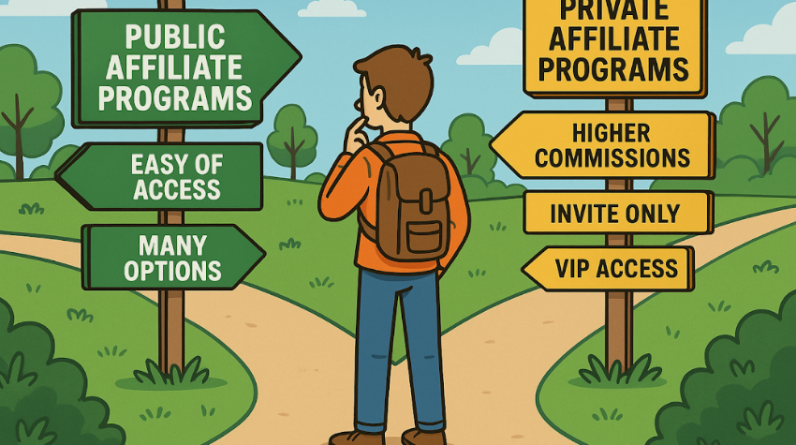
Public Affiliate Programs: Quick Access, Low Barriers
Public affiliate programs are everywhere. You’ll find them on big networks like Amazon Associates, ShareASale, ClickBank, CJ, and Impact. They’re made to be easy: sign up, get a link, paste it, done.
That low barrier makes them a great starting point—especially if you’re new and just want to test the waters.
Why they’re great:
- Fast, often instant, approval
- Huge product variety across nearly every niche
- One dashboard for tracking, reporting, and links
- No traffic or audience requirements to get in
Sounds pretty ideal, right? And it can be—for a while.
But here’s the trade-off: you’re one of thousands of affiliates. That usually means lower commissions, very little support, and a lot of noise around the same products. You’re competing in a crowded room—and the brand might not even know your name.
Public programs are perfect for getting reps in, testing different angles, and figuring out what actually gets clicks. But once you start finding traction? It’s time to look deeper.
Private Affiliate Programs: Higher Payouts, Real Relationships
Private affiliate programs are a little harder to find—and a little harder to get into. They’re usually run directly by the company, not a big network. Sometimes you’ll find them linked in a site footer. Other times, you’ll need to be invited.
But here’s the thing: what you give up in ease, you gain in quality.
Private programs treat affiliates more like partners than just another referral ID. You’re more likely to get personalized support, inside info, better promo materials, and—most importantly—higher payouts.
Why they’re worth your attention:
- Commissions can be 30–50% (sometimes recurring)
- You’ll get better resources—think swipe copy, tutorials, even webinars
- It’s easier to align with brands and products you actually use
- Less competition means better trust and conversion rates
You’re not just pushing a product. You’re building a relationship—with the brand and with your audience.
Private Programs Come with Friction
Private programs aren’t just waiting around for anyone to join. You usually need:
- A relevant site, traffic source, or niche authority
- A pitch or plan that shows you’ll actually promote
- A bit more admin—multiple dashboards, separate logins, individual payout tracking
- And the initiative to go find them (because they’re not always easy to spot)
But if you’re serious about building a long-term, sustainable affiliate business? That extra friction is usually worth it.
Choosing the Right Fit for You
You don’t need to pick one camp forever—but understanding when each type makes sense is the real unlock.
Here’s how to think about it:
Stick with public affiliate programs when:
- You’re just starting out and need quick access to offers.
- You want to experiment with different niches or product types.
- You’re building review content or listicles for SEO and need lots of product variety.
Move into private programs when:
- You’ve validated a niche and want better commissions for the same effort.
- You’ve built an email list, YouTube channel, or blog audience.
- You want a direct relationship with the brand and extra support to convert.
Use both when:
- You’re diversifying your affiliate income streams.
- You’re testing content ideas with public offers, then scaling with private ones.
- You want flexibility—some offers from each side to round out your monetization.
A Smart Growth Strategy: Start Public, Scale Private
One of the smartest ways to build your affiliate business is to start with public programs, where you can test different topics and audiences quickly.
As you see what your readers respond to—what they click, what they buy, what they ask about—look for private programs that align with those same interests.
For example:
- Promote a ClickBank course to test interest in a niche → Later switch to a private coaching partner that pays more.
- Use Amazon links for physical products → Then reach out to the brand directly once you’ve proven traffic.
This lets you move from generalist to specialist—while increasing your payouts along the way.
Wrap-Up: Choose Like a Pro, Not Like a Beginner
The difference between public and private affiliate programs isn’t just about who hosts them—it’s about how you earn, who you work with, and how much control you want over your affiliate business.
Public programs are easy to start. Private programs are built to scale. Use both strategically, and you’ll be able to grow not just commissions—but relationships, authority, and sustainability.
FAQs
What’s the difference between public and private affiliate programs?
Public programs are open to most people and hosted on large networks. Private programs are selective and often run directly by the brand.
Which pays more—public or private?
Private programs typically pay higher commissions, offer recurring revenue, and provide stronger support.
How can I find good private programs?
Check the footer of tools or courses you already use. Look for affiliate pages or contact the brand directly.
Is it okay to mix both types?
Absolutely. Many successful affiliates start with public networks and then mix in private programs for better ROI.
Do I need a website to get approved for private programs?
Usually, yes. A blog, email list, or YouTube channel with traffic or niche focus will help your application.