



Let’s be real. You’ve seen it. That blog post that reads like it was written by a very enthusiastic filing cabinet. Sentences so stiff and generic they could’ve been pulled from a Terms and Conditions page. Bullet points that say absolutely nothing. An intro that starts with “In today’s digital landscape…”
Yeah. That’s AI gone wrong.
And the kicker? A lot of affiliate marketers are doing exactly this – slapping out AI-generated content, hitting publish, and wondering why their conversions look like a flatline. The content’s technically there. It just sounds like nobody wrote it.
Here’s the thing though: the problem isn’t ChatGPT. The problem is how most people use it.
Done right, knowing how to use ChatGPT for affiliate marketing is genuinely one of the biggest competitive edges you can have right now. You’ll crank out more content, test ideas faster, and write better copy – without losing the voice that makes your audience actually trust you. Let’s get into it.
First, Why ChatGPT Feels So Robotic (And Why It’s Not the Tool’s Fault)
Think about what you’re doing when you type “write me a blog post about affiliate marketing tips.” You’re basically handing the wheel to someone who’s never met your audience, doesn’t know your brand, and has zero context about what makes you different.
So it does what any reasonable system would do – it produces a perfectly average, perfectly bland piece of content. Safe. Forgettable. Robot-flavoured.
ChatGPT is a tool, not a ghostwriter who’s been following your niche for three years. The more you put in, the more you get out. And that’s actually good news – because most of your competition is still treating it like a lazy content vending machine. You won’t.
Give It a Personality Brief (Not Just a Topic)
This is where most people stuff it up. They give ChatGPT a topic. What they should be giving it is a full context dump – and there’s a big difference.
Before you write a single prompt, feed it this:
- Who your audience is (e.g. beginner affiliate marketers, budget-conscious, aged 25–40)
- Your tone (casual, punchy, straight-talking, a bit cheeky)
- Words or phrases you always use (or always avoid)
- The goal of the piece – inform, persuade, rank for a keyword, warm up cold traffic
Something like: “Write for an audience of affiliate marketers who are past the basics but not yet earning full-time. Tone should be casual, direct, and occasionally funny. Avoid corporate jargon. No fluff. Short paragraphs.”
Night and day difference. Suddenly you’re not getting textbook content, you’re getting something that actually sounds like a human wrote it with a purpose.
Use It for the Grind Work, Not the Good Stuff
Here’s where the real leverage is. If you want to use ChatGPT for affiliate marketing without killing your credibility, don’t use it to replace your voice. Use it to eliminate the parts of content creation that eat your time without adding anything special.
Outlines
Staring at a blank doc wondering how to structure a 2,000-word review? Done. Ask ChatGPT for a detailed outline and let it handle the skeleton. You bring the meat.
First Drafts of Boring Sections
Product specs. Disclosure statements. The “what is affiliate marketing” explainer paragraph that’s in every single beginner guide. Let AI handle the boilerplate. You focus on the sections where your opinion and experience actually matter.
Headline and Title Variations
Ask it to spit out 10 title variations for your post. You’ll use one, maybe two. But having options is gold when you’re stuck in title purgatory.
Meta Descriptions and SEO Snippets
Nobody enjoys writing meta descriptions. Feed it your post content, ask it to write three meta description options under 160 characters, and get on with your life.
The Prompt That Changes Everything
Want to know the single most useful prompt structure for affiliate content? Here it is:
“You are a no-fluff affiliate marketing blogger. Write a [section/paragraph/intro] about [topic] targeting [audience]. Tone: [casual/punchy/direct]. Goal: [inform/convert/rank for keyword X]. Keep sentences short. Avoid generic openers. Do not use the phrase ‘in today’s digital world.'”
Sounds simple. But the specificity is doing all the heavy lifting. You’re telling it who it is, who it’s talking to, what the job is, and what to avoid. That last bit – telling it what not to do – is criminally underrated.
The more constraints you give, the better the output. Counter-intuitive, maybe. But true.
Inject Your Own Voice Back In
This is non-negotiable, mate. Whatever ChatGPT gives you? Treat it as a rough draft. Read it out loud. If it doesn’t sound like you – fix it.
Your voice is your brand. It’s why people read your blog instead of the 900 other affiliate sites covering the same topic. The moment you let AI flatten that out, you lose the thing that makes readers come back.
A few quick fixes that bring life back to AI drafts:
- Swap long sentences for short punchy ones. If it takes two breaths to read, split it.
- Add a real example. Something you’ve actually tried, seen, or noticed. ChatGPT can’t fake lived experience.
- Kill the throat-clearing. AI loves to warm up with a preamble before getting to the point. Delete it every time.
- Add your opinion. “I’ve tested this and here’s what actually happened.” That sentence alone is worth more than a thousand AI-generated words.
Smart Ways to Use ChatGPT Specifically for Affiliate Marketing
Beyond blog posts, there’s a whole playbook of ways to use ChatGPT for affiliate marketing that most people aren’t tapping into yet.
Comparing Products Side-by-Side
Feed it the feature lists of two competing products and ask it to draft a comparison section. You edit for accuracy, add your take, and you’ve got a solid comparison post in half the time.
Email Sequences
Got a new lead magnet? Ask ChatGPT to draft a 5-email welcome sequence. Give it the product you’re promoting, the audience, and the vibe. Then polish each one so it reads like you, not a drip campaign from 2014.
Finding Angles You Hadn’t Thought Of
Ask it: “What are 10 pain points someone might have before buying [product]?” You’ll get angles for your review, objections to address in your copy, and probably two or three ideas for future articles. All from one prompt.
Repurposing Existing Content
Got a long blog post? Paste it in and ask for a Twitter thread version. Or a short email. Or a punchy intro for a YouTube video. One piece of content, multiple formats, minimal extra effort. That’s leverage.
The SEO Play: Keywords Without Keyword Stuffing
One thing ChatGPT handles reasonably well is weaving in keywords naturally – but only if you tell it to. Leave that out of your prompt and it’ll write a great article that ranks for absolutely nothing.
Tell it your target keyword upfront. Something like: “I want to rank for ‘best email tools for affiliate marketers.’ Include the exact phrase naturally two or three times and use related terms throughout.”
What you don’t want is keyword stuffing – and if you prompt it wrong, that’s what you’ll get. Repetition that makes Google and your reader both feel a bit queasy.
The sweet spot? Use it to draft keyword-rich sections, then read through and replace any awkward phrasings with natural language. You keep the SEO benefit, ditch the robot vibes.
What ChatGPT Can’t Do (And You Shouldn’t Ask It To)
Look, it’s a genuinely useful tool, but it’s not magic. A few things to keep front of mind:
- It can’t verify facts in real time. Commission rates, product specs, tool pricing – always double-check. AI hallucinates. Not often, but enough to embarrass you.
- It doesn’t know your audience like you do. The nuance, the inside jokes, the specific frustrations your readers have, that’s yours. Protect it.
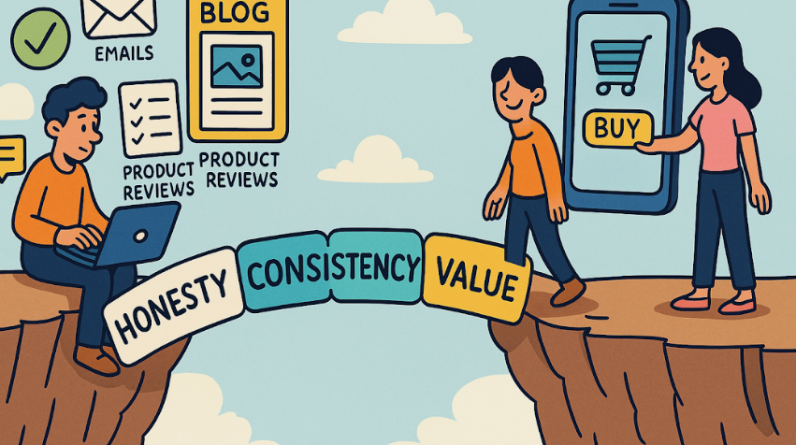
- It won’t build trust on its own. Trust comes from consistent, honest, human content over time. AI can support that. It can’t replace it.
- It can’t tell you what’s working in your niche right now. For that, you still need your own research, testing, and eyes on the market.
A Simple ChatGPT Workflow for Affiliate Articles
Here’s a workflow that actually works without turning your site into an AI content farm:
Step 1 – Research first, AI second. Know the topic. Know what angle you’re taking. Don’t outsource your thinking.
Step 2 – Brief ChatGPT properly. Give it your audience, tone, keywords, goal, and a list of things to avoid.
Step 3 – Get the outline. Review it, tweak it, make sure it covers what your reader actually needs.
Step 4 – Draft section by section. Don’t ask for the whole article in one hit. Do it in chunks and review as you go.
Step 5 – Rewrite and inject voice. Read it out loud. Fix anything that doesn’t sound like you. Add examples and opinions.
Step 6 – Fact-check everything. Commissions, prices, product names, statistics. Every single one.
Bottom Line: AI Is a Co-Pilot, Not the Pilot
The affiliate marketers who are going to win with AI aren’t the ones pressing “generate” and hoping for the best. They’re the ones using it to move faster without sacrificing the quality and personality that makes their content worth reading in the first place.
When you properly learn how to use ChatGPT for affiliate marketing, you’re not replacing your work – you’re multiplying it. More articles. More emails. More content ideas. More time to focus on the strategy and testing that actually moves the needle.
So stop typing “write me a blog post about X” and then being surprised when it reads like a Wikipedia page had a baby with a corporate newsletter.
Be specific. Be intentional. Edit like your reputation depends on it – because it does.
Now go make it work for you.