


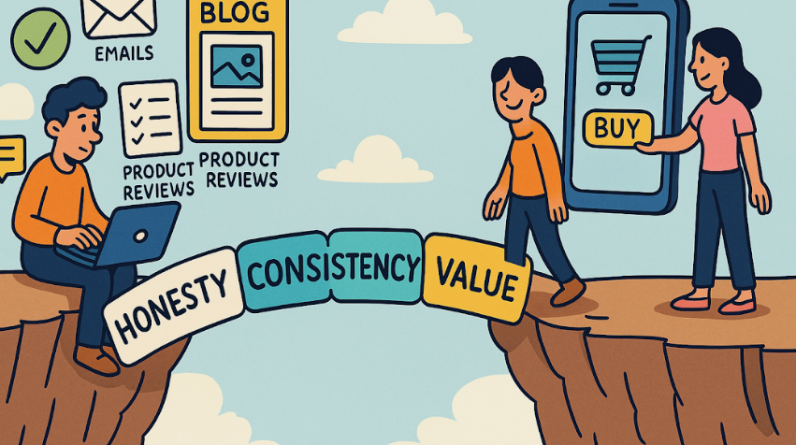
Affiliate marketing can mess with your head. You do all the “right” things—tight SEO, quality content, legit programs—and still… silence. No clicks. No commissions. Just tumbleweeds in your dashboard.
Why? Because the part most people skip—the part that makes or breaks this business—is trust.
Trust is what turns a casual reader into a buyer. It’s the thing that makes someone click your link instead of opening Amazon in a new tab and cutting you out of the loop entirely. It’s also the reason they come back later—even when your competitors are throwing discounts around like confetti.
But here’s the good news: trust isn’t magic. You don’t have to “wait” for it to build. You can engineer it—genuinely—by showing up in the right ways. Let’s break it down.
Trust Isn’t Just a Feeling—It’s a Funnel
Think of trust like a funnel, not fluff. It’s built in stages:
- Credibility: You sound like you know what you’re doing.
- Relatability: You speak your reader’s language.
- Reliability: You’ve shown up before and delivered.
If you’re getting traffic but no conversions, it’s usually one of these steps that’s leaking. Your job? Find the crack and patch it.
Drop the Script—Use a Voice That Sounds Human
Nobody trusts a walking brochure. You know the type—blogs that read like they were written by ChatGPT with a quota to hit. Readers want to hear from a person, not a pitch deck.
Start by ditching the stiff language. Write like you’re talking to one person, not a stadium. If you wouldn’t say it out loud, don’t type it.
Take Matt Giovanisci, for example. His sites—Money Lab and Swim University—don’t read like they’re trying to impress anyone. They’re smart, funny, brutally honest, and packed with firsthand experience. That voice? It sells. Because it feels real.
Back It Up with Proof (Even if You’re Faceless)
You don’t need a ring light or TikTok channel to prove you’ve used the product. But you do need to show, not just tell.
That means screenshots, photos, a walkthrough, a story. Anything that proves you’ve touched the thing you’re talking about—or at least did your homework like a grown-up.
Allie Casazza, a digital product affiliate, does this brilliantly. She talks openly about what she doesn’t promote, shares behind-the-scenes of the things she uses daily, and gives her audience the real story—not the sales pitch. That honesty builds serious buy-in.
Say the Quiet Part Out Loud—You’re Earning Commission
Don’t bury your disclosures in fine print or tuck them at the bottom of the page like a tax warning. If you’re using affiliate links, own it.
Here’s how to say it without sounding like a legal notice:
“Heads up: I may earn a small commission if you buy through my links—no extra cost to you, and it helps keep the lights on.”
This kind of transparency doesn’t hurt conversion. It improves it—because readers know you’re not hiding anything. Just look at how Pat Flynn has handled this for years. Every post, podcast, or video includes a heads-up, often right up top. And guess what? People still buy—because they trust him.
Only Recommend Stuff That Makes Sense for Your People
It doesn’t matter how high the commission is—if the product doesn’t help your reader, don’t touch it.
Say you run a site on minimalist budgeting. Recommending $400 headphones or crypto apps just because they convert? That’s how you kill your authority.
Your audience is asking, “Will this solve my problem?” If the answer’s even sort of no, skip it.
That’s why affiliates like Spencer Haws stay laser-focused on relevance. His product roundups and reviews are tightly aligned with his niche. And when he talks about a tool, it’s usually because he’s used it, tested it, and believes it serves his readers well—not because it happens to pay well.
Consistency Is the Quiet Superpower No One Talks About
One-off “epic” posts don’t build trust. Showing up with useful content, over and over again, does.
This isn’t just about publishing frequency. It’s about tone, values, and follow-through. Your readers should know what to expect from you—and get it, every time.
Doesn’t matter if you post once a week or once a month. Just show up, stay relevant, and keep your quality bar high. That’s how people learn to count on you.
Be a Human—Even If You’re Behind the Scenes
You don’t have to be a personal brand to act like a person. Reply to a blog comment. Say thanks in your email list. Ask your audience what they want more of.
Simple gestures build massive goodwill—and that trust carries into every product you recommend.
The Affiliates Who Nail Trust-Building (Without Trying Too Hard)
Let’s call it what it is: some people just get this.
Matt Giovanisci’s mix of humor, transparency, and tested insights makes his readers feel like they’re getting advice from a smart friend—not a marketer.
Allie Casazza shows up like a human first, affiliate second—and her readers trust her to filter the noise.
Pat Flynn? He’s turned transparency into a business model. When something doesn’t work, he says so. That’s why people still listen when he says something does.
They’re all different. But what they share is this: they’re not trying to game the system. They’re just showing up, honestly, and serving first. That’s what earns clicks—and keeps them coming.
FAQs
Do I need to show my real identity to build trust?
Not necessarily. You can build trust under a pen name or brand name—just be consistent, clear, and honest.
Should reviews always be 100% positive?
Nope. A good review includes the downsides too. Real people weigh pros and cons before buying.
Is it okay to promote products I haven’t personally used?
Only if you’re upfront about that. Focus on compiling helpful research or user feedback—not pretending you’ve tested it.
How do I know if my audience trusts me?
Look for signals: email replies, repeat traffic, engagement, and direct questions like “Would you recommend X?”
What destroys trust fastest?
Pushing irrelevant offers, sounding like a robot, or acting like an expert when you’re clearly winging it.