


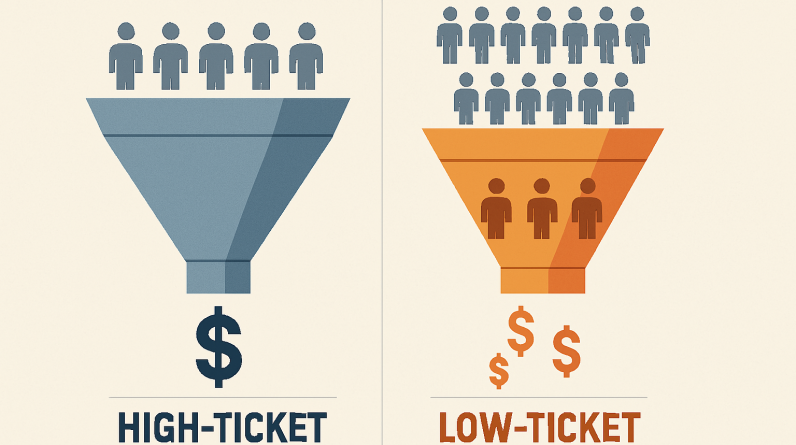
So you’re dipping your toes (or maybe diving headfirst) into affiliate marketing. First big fork in the road? Deciding whether to chase high-ticket offers or stack low-ticket ones like pancakes.
Seems simple, right? Big commission vs. small commission. But nah—it’s not just about the numbers. It’s about how you work, who you’re talking to, and what kind of hustle you’re ready to sign up for.
Let’s break this down, friend-to-friend. No jargon. No fluff. Just what you need to know to make a smart call.
What Counts as High-Ticket?
High-ticket affiliate offers are the fancy stuff. We’re talking products or services that run a few hundred bucks to a couple thousand. You push one, and boom—$200, $500, maybe even $2K lands in your account.
It’s not magic—it’s math. Sell a $2,000 product with a 40% cut, and you pocket $800. That’s not bad for one sale.
But here’s the catch: people don’t drop that kind of cash without thinking. You’ve gotta earn their trust. That means better copy, stronger funnels, maybe even hopping on a call. It’s not just selling a product—it’s selling belief. Big boy (or girl) marketing.
What’s a Low-Ticket Offer, Then?
Now flip it. Low-ticket stuff is cheap and cheerful. Think $10 ebooks, $30 kitchen gadgets, or that $50 course someone whipped up over a long weekend.
Commissions? They’re smaller—maybe a few bucks per sale. But the upside? Easier to move. No one needs to “talk to their spouse” before buying a $25 gadget that slices avocados six ways.
It’s fast. It’s simple. And it plays nice with blogs, TikToks, quick reviews—content that doesn’t take three weeks and a video crew to make.
But don’t get it twisted: to make real money here, you need volume. A lot of it. You’re not gonna retire on five-dollar commissions unless you’re cranking out content like a machine.
Buyer Behavior: The Brain Game
High-ticket buyers? They’re in “solution mode.” They’ve got a real problem, and they’re hunting for the fix. These folks do their homework. They want testimonials, trust, and maybe a heart-to-heart before they swipe their card.
That’s why high-ticket marketing often leans on email sequences, webinars, or straight-up sales calls. You’re not just pushing features—you’re pitching change.
Low-ticket buyers are the “scroll and buy” crowd. They’re on Instagram, see something cool, and boom—sold. No funnel, no warm-up, just an impulse decision made between texts.
That’s why platforms like TikTok, Pinterest, and quick-hit blogs are gold for low-ticket. It’s fast food for the marketing world.
Show Me the Money: Payouts and Profit
Let’s talk cheddar.
- High-ticket: You sell one $1,000 product with a 30% cut. That’s $300 in your pocket. Four of those a month, and you’re at $1,200.
- Low-ticket: You promote a $30 item with a 10% cut. That’s $3 a sale. To hit the same $1,200? You need 400 sales. Hope your content game is tight.
Now, here’s a wrinkle: high-ticket stuff sometimes drags on payouts. There might be refund windows or minimum thresholds. Low-ticket usually pays faster and more often—great if you’re just starting out and need to keep the lights on.
How Long Does It Take to Make a Sale?
Speed matters. Low-ticket is quick. Someone reads a post, watches a video, and buys within minutes. Done.
High-ticket takes time. Think weeks, maybe months. You’re building a funnel, warming them up, nudging them along. But once it clicks? You can hit payday while sipping coffee because your system does the heavy lifting.
Dial in a good funnel, and high-ticket becomes way more chill long-term.
How You Market Depends on the Ticket
High-ticket needs trust. That means meaty content. Case studies, webinars, lead magnets that don’t suck. You’re not slinging socks—you’re selling outcomes.
Low-ticket? You go wide and fast. Product lists, quick demos, Instagram stories, SEO blogs. You’re not building a relationship—you’re making a first impression that sells.
SEO especially loves low-ticket. Drop a “Top 10 gadgets under $20” post and let it ride.
Traffic and Scaling: What’s Gonna Grow?
High-ticket scales with strategy. Paid ads, email lists, YouTube content—this is sniper-mode marketing. You don’t need everyone, just the right ones.
Low-ticket scales with volume. More traffic, more content, more eyes. You’re throwing hooks in every pond you can find.
But remember: scaling low-ticket takes energy. You’ve gotta feed the content beast constantly. High-ticket? Slower start, but smoother ride once the machine’s humming.
High-Ticket: Quick Hit Pros & Cons
Pros:
- Big payouts
- Fewer sales needed
- Great for subscriptions and coaching-type stuff
- Works well with tight niches
Cons:
- Takes longer to convert
- Needs solid marketing chops
- Higher risk of refunds
- Sometimes you’ve gotta talk to humans (ugh)
Low-Ticket: Quick Hit Pros & Cons
Pros:
- Easier for beginners
- Faster conversions
- Works on cold traffic
- Lower pressure per sale
Cons:
- You need a ton of sales
- Can eat up your time with content
- Tough to scale without systems
So… What Should You Actually Promote?
Here’s the truth: there’s no one-size-fits-all answer. It depends on who you’re talking to, what you’re good at, and how much effort you’re ready to put in.
Got a warm audience and a funnel that works while you sleep? Go high-ticket and thank yourself later. Still building your platform and want fast wins? Low-ticket is your launchpad.
Or do both. Many smart marketers start with low-ticket to get people in the door and then upsell the big stuff once they’re warmed up. It’s like offering free samples before selling the whole cake.
Final Take
This isn’t about choosing sides—it’s about choosing what fits you. High-ticket and low-ticket both have their place. Know your strengths. Know your people. And don’t be afraid to test the waters.
At the end of the day, the best affiliate offer is the one you believe in—and can promote without sounding like a late-night infomercial.
FAQs
Can I do both?
Yeah, and you probably should. Low-ticket builds trust. High-ticket brings the real cash.
Best for email marketing?
High-ticket wins here. You’ve got more room to nurture. But don’t sleep on low-ticket flash sales either.
Harder to get into high-ticket programs?
Sometimes. They want experienced affiliates. But if you’ve got the chops, it’s worth the ask.
Low-ticket work better on social?
For sure. Scroll, click, buy. Perfect for short videos and quick mentions.
How do I pick what fits my niche?
Think like your audience. Are they looking to save money—or spend it to solve a big problem? Match your offer to their mindset.